
Stair Safety For Seniors: Why Staircases Become More Dangerous After Age 70
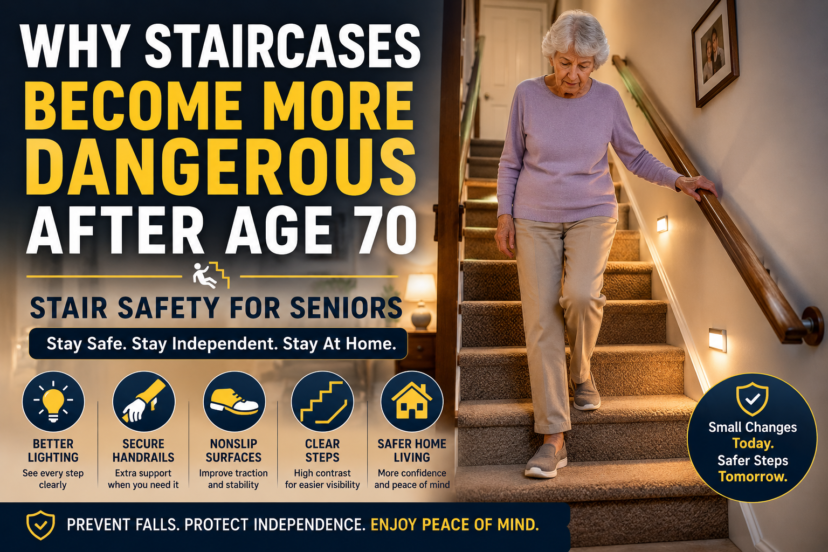
How to improve stair safety for seniors? A staircase you have climbed safely for decades can gradually become one of the most challenging areas of your home. After age 70, changes in balance, vision, muscle strength, reaction time, and joint mobility can make stairs harder to navigate—even when you still feel active and independent.
Improving stair safety for seniors does not necessarily mean avoiding stairs or moving to a one-story home. In many cases, simple changes such as stronger handrails, better lighting, improved contrast, and removing loose rugs can make a meaningful difference.
For older adults who want to remain at home, the goal is to make the environment work better as needs change. Caregivers can help by looking at the staircase with fresh eyes and identifying small hazards that may have gone unnoticed for years.
The good news is that many stair-safety improvements are inexpensive, practical, and possible without a major home renovation.
🪜 Quick Answer: Stair Safety For Seniors
Improving stair safety for seniors starts with secure handrails, consistent lighting, clear steps, nonslip surfaces, and good visual contrast between individual stair treads. Older adults should avoid carrying bulky objects that block their view of the steps and should use the handrail whenever possible. If stairs have become difficult because of balance, strength, vision, or mobility changes, a professional home safety evaluation can help identify appropriate solutions.
Key Takeaways
- Most likely cause: Age-related changes in balance, strength, vision, coordination, and mobility can make climbing and descending stairs more difficult.
- Usually serious? Stair hazards can become serious because a fall on stairs may cause significant injury, particularly for an older adult.
- First thing to check: Examine handrails, lighting, loose carpeting, clutter, stair edges, and whether each step is easy to distinguish from the next.
- Best solution: Improve stair safety for seniors with secure handrails, better lighting, nonslip surfaces, high-contrast stair edges, and professional assessment when mobility or balance problems are present.
⚠️ Why Stairs Can Become More Dangerous After Age 70
Stairs require more physical coordination than we sometimes realize.
Every step involves lifting a foot to a specific height, shifting body weight, maintaining balance, judging distance, and preparing for the next step. Going downstairs can be especially demanding because the body must remain controlled while moving forward and downward.
Several normal age-related changes can make these movements more challenging.
An older adult may need more light to see stair edges clearly. Leg muscles may not generate quite as much power. Arthritis or stiffness may affect how easily the knee, hip, or ankle moves.
Reaction time can also change. If a foot catches the edge of a step, recovering balance may be more difficult than it was years earlier.
That does not mean everyone over 70 will have trouble with stairs. Aging varies greatly from person to person. Instead, age is a useful reminder to reassess a staircase that may have been designed decades ago without older adults in mind.
👀 1. Vision Changes Make Steps Harder To Judge
Stairs often use identical materials and colors from top to bottom. While that may look attractive, it can make individual steps harder to distinguish.
Low contrast becomes particularly problematic in dim lighting.
The edge of one stair can visually blend into the next, making it harder to judge where the foot should land.
For better stair safety for seniors, consider creating clearer visual contrast at stair edges using appropriate contrasting materials or professionally installed stair-edge markings.
Avoid highly patterned carpeting that makes individual steps difficult to identify.
💪 2. Leg Strength Can Gradually Decline
Climbing stairs requires strength in the legs, hips, and core.
Descending requires controlled muscle activity to lower the body safely from one step to another.
If strength has declined, an older adult may begin pulling heavily on the handrail, taking stairs very slowly, or feeling exhausted before reaching the top.
These changes should not automatically be dismissed as “just getting older.”
A healthcare provider or physical therapist can help determine whether appropriate strength and balance exercises could improve mobility.
⚖️ 3. Balance Changes Increase The Risk Of A Misstep
Stairs leave little room for balance errors.
On a flat floor, someone who briefly loses balance may have enough space to recover. On stairs, the next surface may be several inches lower.
This is one reason secure handrails are so important.
A person should not have to reach across an open staircase or depend on a decorative railing that is difficult to grip.
When practical and consistent with local codes, properly installed graspable handrails on both sides can provide additional support.
💡 4. Poor Stairway Lighting Creates Hidden Hazards
A staircase may look adequately illuminated during the afternoon but become surprisingly dark at night.
Shadows can hide stair edges and make changes in elevation harder to recognize.
Good stairway lighting should illuminate the entire staircase, including the top and bottom landings.
Useful improvements may include:
- Brighter Stairway Fixtures
- Light Switches At Both Ends Of The Stairs
- Motion-Activated Lighting
- Low-Level Step Lighting
- Night Lights Near Landings
Avoid creating excessive glare, which can also interfere with visibility.
🖐️ 5. Inadequate Handrails Remove An Important Safety Tool
A handrail is more than decoration.
It should be secure, easy to grasp, and positioned so a person can maintain a comfortable grip while using the stairs.
Check for movement by gently testing existing rails. A loose handrail should be repaired promptly.
Some older homes have a handrail on only one side. Adding a second properly installed handrail may provide additional stability for some users.
Handrail design and installation should comply with applicable local building codes.
👟 6. Slippery Steps Increase The Chance Of Falling
Smooth wood, polished surfaces, loose carpeting, or worn stair coverings can make stairs slippery.
Loose runners are particularly concerning because they can shift or create raised edges.
Improving traction may involve repairing damaged flooring, securing carpeting, or installing an appropriate nonslip surface designed for stair use.
Footwear matters too.
Shoes or slippers should fit properly and provide stable traction. Loose slippers and walking around in slippery socks may increase the chance of losing footing.
📦 7. Carrying Items Can Block The View Of The Stairs
Laundry baskets, grocery bags, boxes, and other household items can create a problem when they prevent someone from seeing where the next step begins.
They can also prevent the use of a handrail.
A simple rule can improve stair safety for seniors: avoid carrying anything large enough to block your view or prevent you from maintaining safe support.
Families can also reduce unnecessary trips by keeping commonly used items on each floor or finding alternative ways to transport heavier objects.
🧸 8. Clutter Creates Unexpected Obstacles
Stairs should never become temporary storage.
Shoes, books, packages, laundry, pet toys, electrical cords, and decorative objects can quickly turn into trip hazards.
Keep the entire stairway clear, including the top and bottom landings.
Caregivers should also check stairs from the older adult’s perspective. Small objects that are easy for younger eyes to notice may be much harder to see in dim lighting.
🎨 9. Low Contrast Can Make Stair Edges Disappear
A staircase made entirely from one color can make depth perception more difficult.
Adding visual contrast between the tread edge and surrounding surface may make each step easier to identify.
The solution should be simple and consistent.
Avoid complicated patterns or highly reflective materials that could create visual confusion.
If an older adult has significant vision impairment, an occupational therapist or vision rehabilitation professional may provide more individualized recommendations.
🚪 10. The Top And Bottom Landings May Be Overlooked
People often focus entirely on the steps and forget about the areas immediately surrounding them.
Landings should be clear, well illuminated, and free of loose rugs or furniture that interferes with movement.
Make sure doors near stairs do not create unexpected obstacles.
Light switches should also be conveniently accessible so nobody needs to navigate a dark staircase before turning on the light.
🛠️ How To Make Stairs Safer Without A Major Remodel
You do not necessarily need an expensive renovation to improve an existing staircase.
Start with the easiest changes.
Improve Lighting
Replace inadequate bulbs or fixtures and consider automatic lighting where appropriate.
Secure The Handrails
Repair loose rails and evaluate whether additional handrail support would help.
Clear Every Step
Remove anything stored on the staircase or landings.
Improve Traction
Repair damaged surfaces and address slippery or loose flooring.
Increase Visual Contrast
Make individual stair edges easier to distinguish when needed.
Review Footwear
Choose properly fitting footwear with stable, nonslip soles.
These relatively small changes can make the staircase feel more predictable and easier to navigate.
🏡 When Should You Consider Alternatives To Stairs?
Sometimes home modifications are not enough.
If an older adult is repeatedly falling, struggling significantly with stairs, becoming exhausted while climbing, or avoiding part of the home because of the staircase, it may be time to discuss alternatives.
Depending on the individual and the house, options might include reorganizing the home so essential living areas are on one floor, installing an appropriate stair lift, or considering other accessibility modifications.
Do not wait for a serious fall before discussing these possibilities.
Planning early usually provides more options and allows the older adult to participate fully in the decision.
👷 When To Consult A Professional
Professional guidance is important when stair difficulties involve significant balance problems, weakness, dizziness, vision changes, repeated falls, or other changes in mobility.
A healthcare provider or physical therapist can evaluate medical and mobility concerns. An occupational therapist can assess how someone performs everyday activities within the home and suggest practical modifications.
For structural improvements, consider a certified aging-in-place specialist (CAPS), qualified home accessibility installer, licensed contractor, or other appropriate professional.
Changes to stairs, railings, electrical systems, or structural components should meet applicable local building codes and installation requirements.
❓ FAQs About Stair Safety For Seniors
How Can I Make Stairs Safer For An Elderly Person?
Start with secure handrails, good lighting, clear steps, stable nonslip surfaces, and improved contrast at stair edges when necessary. Remove clutter and repair loose carpeting or damaged flooring promptly.
Should Seniors Have Handrails On Both Sides Of The Stairs?
Two properly installed handrails may provide additional support and allow a person to use the rail that is most comfortable. Installation should follow applicable building codes and individual accessibility needs.
What Is The Best Flooring For Stairs For Seniors?
A stable, securely installed, nonslip surface is generally preferable. Avoid loose runners, damaged carpet, highly slippery finishes, and materials that make stair edges difficult to distinguish.
Are Stair Treads Good For Seniors?
Properly installed nonslip stair treads may improve traction, but poorly secured products can become hazards themselves. Choose products specifically designed for stairs and follow installation instructions carefully.
Are Stair Lifts Safe For Seniors?
A properly selected and professionally installed stair lift can be useful for some people with mobility limitations. Suitability depends on the individual, staircase design, and home environment, so professional evaluation is recommended.
At What Age Should Seniors Stop Using Stairs?
There is no specific age when everyone should stop using stairs. Ability varies widely. Balance, strength, vision, mobility, medical conditions, and fall history are more important than age alone.
What Should I Do If My Parent Is Suddenly Struggling With Stairs?
A noticeable change in stair-climbing ability deserves attention. Consider contacting their healthcare provider, particularly if the difficulty is new or accompanied by weakness, dizziness, pain, shortness of breath, or changes in balance.
📌 Final Thoughts On Stair Safety For Seniors
Turning 70 does not automatically make stairs unsafe. But it is a good time to look at familiar surroundings with a fresh perspective.
Small changes in vision, strength, balance, and mobility can transform an ordinary staircase into a more demanding part of daily life.
Fortunately, improving stair safety for seniors can often begin with simple changes: better lighting, stronger handrails, clearer stair edges, improved traction, and clutter-free walking areas.
Start with what you can change today. Then pay attention to how comfortably and confidently the staircase is being used.
Aging in place is not about pretending that needs never change. It is about adapting the home thoughtfully so older adults can continue living safely, comfortably, and independently for as long as possible.
Disclaimer: This content is for general informational purposes only and is not a substitute for professional medical, healthcare, home accessibility, or safety advice. Follow applicable local building codes and manufacturer instructions. Consult qualified healthcare providers, occupational or physical therapists, contractors, electricians, home accessibility professionals, or certified aging-in-place specialists before making significant home modifications or beginning new exercise routines.
 Explore more:
- How To Help Aging Parents Stay At Home?
- Best Smart Home Devices For Seniors
- Best Night Lights For Seniors


Comments are closed.