Typical Stair Lift Cost: What Most Families Don’t Expect Before Buying
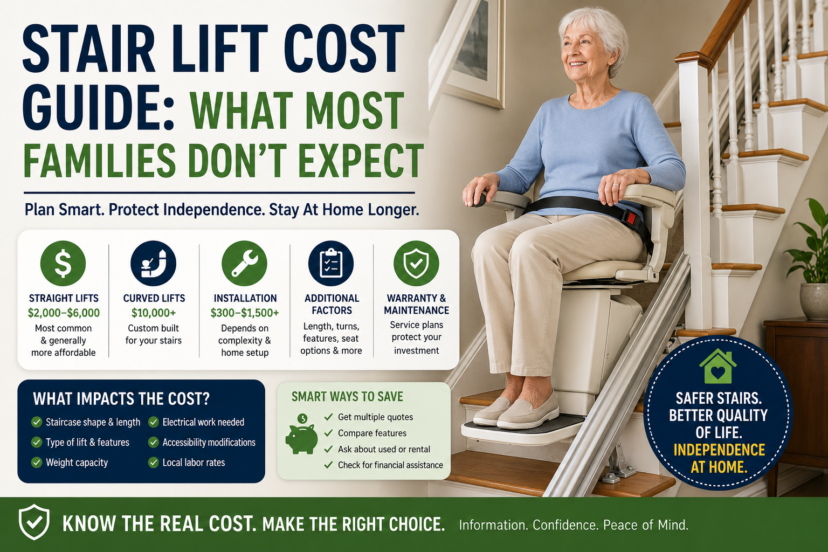
When stairs become difficult or unsafe, families often assume they have only two choices: move to a one-story home or spend a fortune on remodeling. A stair lift can offer another option, allowing an older adult to continue using multiple levels of a familiar home with less physical strain. But the typical stair lift cost can be confusing. The advertised price is rarely the only number that matters. The shape and length of the staircase, installation requirements, electrical work, optional features, maintenance, and whether the equipment is new, used, or rented can all affect the final bill.
For many families, the goal is not simply to find the cheapest lift. It is to find a safe, dependable solution that fits both the person and the home.
Understanding what determines the price before requesting estimates can help you ask better questions, avoid unnecessary upgrades, and make a more confident aging-in-place decision.
💰 Quick Answer: Typical Stair Lift Cost
A typical stair lift cost in the U.S. can range from roughly $2,000 to $6,000 for many basic straight-stair installations, while custom curved stair lifts may cost $10,000 or considerably more. Prices vary by staircase design, track length, lift features, installation requirements, and local labor costs. Always request an itemized quote that explains the equipment, installation, warranty, and possible additional charges.
Key Takeaways
- Most likely cause: The biggest factor affecting price is usually staircase design. Straight stairs are generally simpler and less expensive than curved or multi-landing staircases.
- Usually serious? The expense can be significant, but it may be reasonable when compared with major remodeling or moving, depending on the household.
- First thing to check: Determine whether the staircase is straight, curved, unusually narrow, or interrupted by landings, doors, or other obstacles.
- Best solution: Compare several itemized estimates for the total typical stair lift cost, including equipment, professional installation, warranty coverage, maintenance, and any necessary home modifications.
🏠 Why Stair Lift Prices Vary So Much
Two houses that look similar from the outside can require completely different stair lift installations.
A simple straight staircase between two floors is generally the easiest situation. Many straight stair lifts use standardized track systems that can be adjusted to the length of the staircase.
Curved staircases are different.
The track often has to follow the exact shape, angle, and turns of the stairs. That customization requires additional measuring, manufacturing, and installation work.
Other factors affecting stair lift prices can include:
- Staircase Length
- Number Of Turns
- Intermediate Landings
- Seat And Footrest Options
- Weight Capacity
- Folding Rails
- Power-Swivel Seats
- Outdoor Installation
- Electrical Requirements
- Local Installation Costs
That is why comparing advertised “starting at” prices can be misleading.
What matters is the installed price for your particular home.
💵 How Much Does A Straight Typical Stair Lift Cost?
Straight stair lifts are usually the least expensive option.
For a relatively standard staircase, families may see prices starting in the low thousands and extending to around $6,000 or more depending on the manufacturer, model, features, and installation.
A straightforward installation generally includes a rail attached to the stair treads rather than the wall, a powered chair, controls, safety sensors, and charging equipment.
The final price may rise if you need features such as:
- Higher Weight Capacity
- Powered Folding Footrests
- Powered Swivel Seats
- Folding Or Hinged Rails
- Additional Remote Controls
- Special Upholstery Or Seat Sizes
Do not assume every optional feature is necessary.
Ask the installer which features address an actual safety or accessibility need for the person using the lift.
↪️ How Much Does A Curved Typical Stair Lift Cost?
Curved staircases are where the typical stair lift cost can increase dramatically.
Prices of $10,000 or more are common for customized systems, and complicated installations may cost significantly more.
The reason is largely the rail.
Instead of installing a standard straight track, the company may need to create a rail designed specifically for the staircase.
That can include:
- Multiple Turns
- Spiral Sections
- Intermediate Landings
- Changes In Stair Angle
- Parking Areas Away From The Stairs
- Travel Across More Than One Flight
Custom manufacturing can also increase delivery time.
Before purchasing a curved stair lift, ask whether the rail is custom built, how long manufacturing is expected to take, and what happens to the equipment if the lift is no longer needed.
🧾 What Most Families Don’t Expect About Typical Stair Lift Cost
The equipment itself gets most of the attention, but several other expenses can influence the final budget.
1. Electrical Work May Be Needed
Many modern stair lifts operate using rechargeable batteries, but the batteries still require charging from household electricity.
If there is no appropriate electrical outlet near the staircase, an electrician may need to install one.
Ask whether electrical preparation is included in the quote.
2. A Doorway May Complicate Installation
A stair lift rail may extend beyond the bottom step and interfere with a doorway or walking path.
A hinged or folding rail may solve the problem, but it can increase the price.
3. Wider Or Higher-Capacity Seats Can Cost More
Not every standard seat fits every user comfortably.
A professional assessment should consider height, weight, hip width, ability to transfer, and how comfortably the person can operate the controls.
4. Maintenance Is An Ongoing Expense
A stair lift contains moving mechanical and electrical components.
Ask what routine maintenance is recommended, how much service visits cost, and whether annual servicing is included during the warranty period.
5. Batteries Eventually Need Replacement
Battery life varies depending on the lift, usage, environment, and manufacturer.
Ask about expected battery replacement intervals and current replacement costs before purchasing.
🔧 Installation Costs: What Should Be Included?
Some companies include standard installation in the advertised stair lift price, while others charge separately.
This is why an itemized written quote is important.
The estimate should clearly identify:
- Stair Lift Equipment
- Track Or Rail
- Professional Installation
- Required Electrical Work
- Optional Accessories
- Delivery Charges
- Sales Tax Where Applicable
- Warranty Coverage
- Service Or Maintenance Plans
Also ask what could cause the quoted price to change.
You do not want to discover halfway through installation that an important component was excluded.
♻️ Can A Used Stair Lift Save Money?
Buying used or reconditioned equipment can lower the cost in some situations.
Straight stair lifts are usually better candidates because their rails can often be adapted to another staircase of a similar configuration.
Curved lifts can be more complicated because the rail may have been custom manufactured for another home.
When considering a used lift, ask:
- Who Inspected The Equipment?
- How Old Is The Lift?
- Is Installation Included?
- What Warranty Is Provided?
- Are Replacement Parts Still Available?
- How Old Are The Batteries?
Buying inexpensive equipment privately may seem attractive, but professional inspection and proper installation are important safety considerations.
📅 Is Renting A Stair Lift Cheaper?
Rental may make sense when the need is temporary.
For example, someone recovering from surgery or temporarily experiencing mobility limitations might need a stair lift for several months rather than several years.
Rental arrangements can include an installation fee, monthly rental charge, removal fee, or minimum rental period.
Compare the total expected rental expense with purchasing.
For long-term aging in place, buying may eventually become more economical, but the break-even point depends on the specific rental program.
🩺 Does Medicare Pay For Stair Lifts?
Families are often surprised to learn that Original Medicare generally does not pay for stair lifts simply as a home modification.
Coverage situations can vary with other insurance arrangements, benefits, or programs, so it is important to verify your specific coverage rather than assuming.
Some people may have access to assistance through Medicaid waiver programs, certain Medicare Advantage supplemental benefits, veterans’ programs, state or local aging programs, nonprofit organizations, or other sources.
Eligibility and benefits vary widely.
Contact the relevant program directly before purchasing if financial assistance will affect your decision.
🎖️ Can Veterans Get Help Paying For A Stair Lift?
Some U.S. veterans may qualify for benefits or programs that assist with medically necessary accessibility modifications.
Eligibility depends on individual circumstances and the specific program.
If you or your spouse is a veteran, consider contacting the U.S. Department of Veterans Affairs or an accredited veterans’ service representative before purchasing equipment.
Do not rely solely on a salesperson’s description of available benefits.
🛒 How To Compare Stair Lift Quotes
Comparing only the bottom-line price can lead to the wrong decision.
Instead, compare the entire package.
Ask each company the same questions:
- What Is The Complete Installed Price?
- Which Features Are Included?
- What Is Not Included?
- How Long Is The Warranty?
- Who Provides Local Repairs?
- What Does A Typical Service Call Cost?
- Are Parts Available Locally?
- What Happens During A Power Outage?
- How Much Do Replacement Batteries Cost?
- Is Removal Included If The Lift Is No Longer Needed?
A slightly higher initial price may represent better value if it includes stronger warranty protection and dependable local service.
⚖️ Is A Stair Lift Worth The Cost?
The answer depends on how the home is used and what alternatives are available.
Suppose the bedroom and full bathroom are upstairs, but an older adult is beginning to struggle with stairs. Relocating those rooms to the first floor might require substantial remodeling.
Moving to another house can be even more disruptive and expensive.
In that situation, a stair lift may allow the person to continue using the existing home with fewer changes.
But a stair lift is not automatically appropriate for everyone.
The person must generally be able to safely get onto and off the seat, remain appropriately positioned during travel, and use the equipment according to its instructions.
A professional assessment can help determine whether a stair lift actually addresses the person’s mobility needs.
🏡 Ways To Reduce The Typical Stair Lift Cost Without Sacrificing Safety
There are several reasonable ways to control costs.
- Get Multiple Quotes: Compare several qualified installers rather than accepting the first estimate.
- Choose Necessary Features: Avoid paying for upgrades that provide little practical benefit.
- Consider Reconditioned Equipment: A professionally inspected used straight lift may reduce costs.
- Ask About Rental: Temporary mobility problems may not require purchasing.
- Check Assistance Programs: Investigate veteran, Medicaid, state, local, or nonprofit programs before paying out of pocket.
- Compare Warranties: A cheaper lift with expensive future repairs may not provide the best long-term value.
Safety, reliability, and professional installation should remain the priority.
👷 When To Consult A Professional
Before purchasing a stair lift, consider having the user and staircase professionally evaluated.
An occupational therapist can help determine whether a stair lift fits the person’s mobility and transfer abilities. A healthcare provider or physical therapist may need to evaluate unexplained weakness, dizziness, balance problems, or sudden difficulty using stairs.
A certified aging-in-place specialist (CAPS), qualified accessibility installer, or experienced contractor can assess the home and identify potential installation issues.
Electrical or structural modifications should be completed by appropriately qualified professionals and follow applicable local codes.
❓ FAQs About Typical Stair Lift Cost
How Much Does A Typical Stair Lift Cost In The U.S.?
Many straight stair lifts may cost approximately $2,000 to $6,000 installed, while customized curved lifts commonly cost $10,000 or more. Actual prices depend on the staircase, equipment, features, and installer.
Why Are Curved Stair Lifts So Expensive?
Curved stair lifts often require a rail manufactured specifically for the staircase. Measuring, designing, manufacturing, and installing that custom rail adds substantially to the cost.
Does Medicare Cover Typical Stair Lift Cost?
Original Medicare generally does not cover stair lifts as standard home modifications. Other insurance or assistance programs may have different rules, so verify benefits directly with your plan or program.
How Much Does It Cost To Rent A Stair Lift?
Rental pricing varies by provider and may include installation, monthly rental, minimum rental periods, and removal charges. Request the total projected cost for the length of time you expect to use it.
Can You Buy A Used Stair Lift?
Yes. Reconditioned straight stair lifts can sometimes provide substantial savings. Have the equipment professionally inspected and confirm the warranty, battery condition, parts availability, and installation costs.
How Long Do Stair Lifts Last?
Service life depends on the manufacturer, model, usage, maintenance, and environment. Regular professional maintenance and timely replacement of worn components can help keep the equipment operating safely.
Does A Stair Lift Add Value To A Home?
A stair lift may make a home more usable for someone with mobility limitations, but it does not necessarily increase resale value. For many families, its primary value is supporting safer access and continued independence.
🎯 Conclusion: Typical Stair Lift Cost
The biggest surprise about typical stair lift cost is often how much the final price depends on the staircase itself rather than simply the chair.
A straightforward staircase may require a relatively simple system, while curves, landings, unusual dimensions, electrical work, and specialized features can quickly increase the budget.
Before buying, slow the process down. Have the user’s needs assessed, obtain multiple itemized estimates, understand ongoing maintenance costs, and investigate any financial assistance that may be available.
Most importantly, think about the larger goal.
A stair lift is not merely another piece of equipment. For the right person and home, it can help restore access to bedrooms, bathrooms, and living spaces that have gradually become difficult to reach.
A thoughtful investment in accessibility can help an older adult continue living in a familiar home with greater safety, confidence, comfort, and independence.
Disclaimer: This content is for general informational purposes only and is not a substitute for professional medical, healthcare, financial, home accessibility, or safety advice. Prices and program benefits vary by location and provider. Follow applicable local building and electrical codes, and consult qualified healthcare providers, occupational therapists, contractors, accessibility installers, electricians, or certified aging-in-place specialists before making significant home modifications or beginning new exercise routines.
 Explore more:
- Stair Safety For Seniors: Why Staircases
- Best Smart Home Devices For Seniors
- Best Night Lights For Seniors