Kitchen Safety For Seniors: 15 Smart Tips To Keep Cooking Safer And Easier
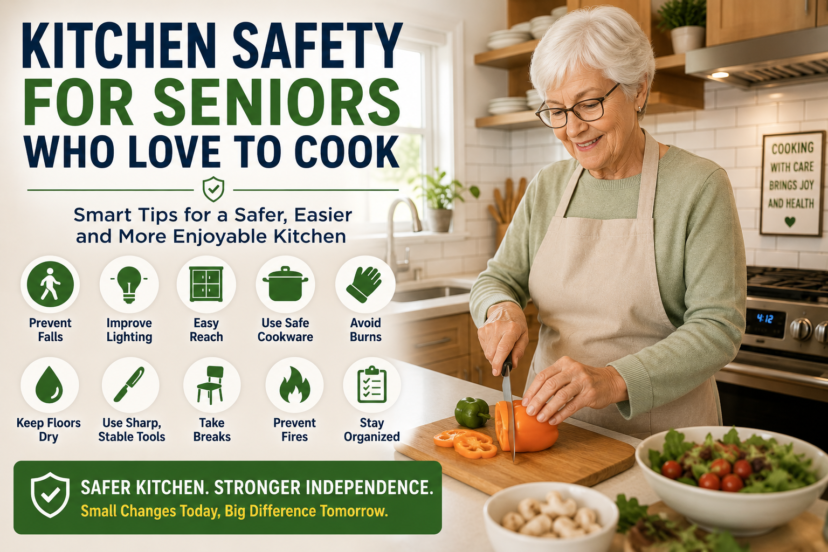
For many older adults, the kitchen is more than a place to prepare meals. It is part of daily independence, family tradition, and the simple pleasure of making favorite foods at home. But as strength, balance, vision, grip, or reaction time changes with age, familiar cooking tasks can become a little harder. Improving kitchen safety for seniors does not mean giving up cooking or completely remodeling the kitchen. Often, a few practical changes can make the space safer, easier to use, and far less stressful.
Moving frequently used items to waist height, improving lighting, reducing slippery surfaces, using easier-to-grip tools, and keeping walking paths clear can all make a meaningful difference.
For caregivers, the goal should be to support independence rather than take it away. A well-organized kitchen can help older adults continue preparing meals confidently while reducing unnecessary bending, reaching, lifting, and fall risks.
🍳 Quick Answer: Kitchen Safety For Seniors
The best ways to improve kitchen safety for seniors are to keep floors clear and dry, improve task lighting, place frequently used items within easy reach, use stable cookware and easy-grip utensils, reduce heavy lifting, and make appliances simpler to operate. Small changes to storage, lighting, flooring, and cooking habits can help older adults continue cooking safely without expensive renovations.
Key Takeaways
- Most likely cause: Falls, burns, cuts, difficulty reaching, heavy lifting, and poor lighting are some of the most common kitchen safety concerns for older adults.
- Usually serious? Many hazards seem minor until they cause a fall, burn, or other injury, so early prevention is worthwhile.
- First thing to check: Look for slippery floors, cluttered walkways, hard-to-reach storage, poor lighting, loose rugs, and appliances that are difficult to use.
- Best solution: Improve kitchen safety for seniors by making everyday tasks easier, reducing unnecessary reaching and lifting, and creating a clear, well-lit cooking area.
🏠 Why Kitchens Can Become Harder To Use With Age
A kitchen requires a surprising amount of physical coordination.
Cooking may involve standing for extended periods, reaching into cabinets, carrying hot pans, opening jars, bending toward lower shelves, reading small labels, and moving quickly between the stove, sink, and refrigerator.
Any of these tasks can become more challenging when mobility or vision changes.
For example, someone with arthritis may struggle to grip a small pot handle. A person with reduced balance may feel less stable while bending into a lower cabinet. Dim lighting can make knife work or reading appliance controls harder.
Good kitchen safety for seniors focuses on removing those unnecessary challenges.
The safest kitchen is not necessarily the newest one. It is the kitchen arranged around the person who uses it.
💡 1. Improve Kitchen Lighting
Good lighting should be one of the first improvements you consider.
A single ceiling fixture may leave shadows over counters, the sink, or stove.
Add bright, even task lighting in frequently used areas. Under-cabinet LED lighting can make countertops easier to see without requiring a major renovation.
Pay particular attention to:
- Food Preparation Areas
- The Stove And Cooktop
- The Kitchen Sink
- Pantry Shelves
- Appliance Controls
- Entrances And Walkways
Avoid excessive glare from highly reflective surfaces.
🚶 2. Keep Floors And Walkways Clear
Kitchen floors can quickly become cluttered with stools, pet bowls, bags, step stools, cords, and other objects.
These can increase the chance of tripping.
Create wide, predictable walking paths between the refrigerator, sink, stove, and table.
Avoid running electrical cords across walkways, and remove items that do not need to be on the floor.
The easier it is to move through the kitchen without stepping around obstacles, the safer the room becomes.
🧽 3. Clean Spills Immediately
Water, cooking oil, dropped food, and condensation can make hard kitchen floors slippery.
Keep towels or paper towels within easy reach so spills can be cleaned quickly.
If a larger spill occurs, take your time and make sure the area is completely dry before walking across it.
A lightweight mop with a long handle may reduce the need to bend or kneel.
This simple habit can significantly improve kitchen safety for seniors because slipping is one of the most preventable household hazards.
🧺 4. Move Frequently Used Items To Easy-Reach Shelves
Storage can make a kitchen either easier or harder to use.
Everyday items should ideally be stored between approximately knee and shoulder height so they can be reached without deep bending or excessive stretching.
Frequently used items might include:
- Plates
- Cups
- Mixing Bowls
- Coffee Supplies
- Pots And Pans
- Cooking Oils
- Everyday Pantry Foods
Heavy cookware should not be stored on high shelves.
Moving commonly used items can be one of the most effective zero-cost kitchen improvements.
🪜 5. Avoid Climbing On Chairs Or Unstable Stools
Standing on a chair to reach a high cabinet is risky at any age.
For an older adult with reduced balance, it can be particularly dangerous.
If an item is used regularly, move it to a lower shelf.
If occasional access to high storage is unavoidable, use a stable step stool designed for the purpose, preferably with an appropriate handhold. Even then, someone with significant balance or mobility limitations may be safer asking for assistance.
The long-term solution is better storage placement, not repeated climbing.
🔥 6. Make Stove And Oven Use Safer
Hot cookware and open heating elements deserve extra attention.
Turn pot handles inward so they are less likely to be bumped while walking past. However, keep handles positioned so they are not directly over another hot burner.
Use back burners when practical, particularly for smaller pots.
Keep towels, paper products, oven mitts, and other flammable materials away from cooking surfaces.
A timer can also help prevent food from being forgotten on the stove or in the oven.
Some newer appliances include automatic shutoff or safety features, which may be useful depending on the household’s needs.
🥘 7. Use Lighter Cookware
Large cast-iron pans and heavy stockpots can become difficult to lift safely.
Consider replacing frequently used heavy cookware with lighter alternatives that have sturdy handles.
Smaller pans can also be easier to control.
For example, instead of carrying a large pot filled with boiling water to the sink, consider using a smaller pot or transferring food using a safe utensil when appropriate.
The goal is to reduce the amount of hot, heavy weight that needs to be moved across the kitchen.
✋ 8. Choose Easy-Grip Kitchen Tools
Arthritis and reduced hand strength can make small handles difficult to use.
Look for utensils with larger, cushioned, or nonslip grips.
Useful examples include:
- Easy-Grip Can Openers
- Jar Openers
- Lightweight Knives With Comfortable Handles
- Large-Handle Peelers
- Easy-Grip Measuring Cups
- Electric Can Openers
Small ergonomic improvements can make cooking more comfortable while reducing hand strain.
🔪 9. Keep Knives Sharp And Store Them Safely
A dull knife may seem safer, but it often requires more force and can slip unexpectedly.
Use properly maintained knives and cut on a stable cutting board.
A non-slip mat underneath the cutting board can help prevent movement.
Store knives in a designated knife block, drawer insert, or other secure location rather than loose in a drawer.
If hand strength or coordination has changed significantly, consider tools designed to provide better control.
🪑 10. Create A Seated Preparation Area
Standing for long periods can be tiring.
A seated workstation can allow someone to chop vegetables, mix ingredients, or prepare simple meals without remaining on their feet the entire time.
Use a sturdy chair with appropriate back support and make sure there is enough legroom.
A pull-out work surface or lower table may also be useful.
For many older adults, this is one of the most practical kitchen safety upgrades for seniors because it reduces fatigue while preserving independence.
🧊 11. Make The Refrigerator Easier To Use
Frequently used foods should be stored where they are easy to see and reach.
Avoid placing heavy containers on very high shelves or near floor level.
Clear containers and simple labels can make food easier to identify.
A lazy Susan or rotating organizer may also help with condiments and smaller items.
Regularly remove expired food, so shelves do not become overcrowded.
An organized refrigerator reduces bending, searching, and unnecessary lifting.
🔌 12. Keep Small Appliances In Safe Locations
Toasters, coffee makers, electric kettles, slow cookers, and other appliances should be positioned where they can be used without stretching over hot surfaces or pulling cords across counters.
Keep appliances away from the edge of the counter.
Make sure cords are intact, and plugs fit securely.
Avoid overloading electrical outlets or using extension cords as permanent kitchen wiring.
Damaged cords, plugs, or outlets should be evaluated by a qualified electrician.
🧯 13. Check Smoke Alarms And Fire Safety Equipment
Every home should have properly installed and functioning smoke alarms.
Test alarms according to manufacturer guidance and replace batteries or units as required.
A suitable fire extinguisher may also be helpful, but the user needs to know how and when to use it safely.
Never attempt to fight a fire that is spreading or putting you at risk.
For cooking oil or grease fires, do not throw water onto the flames.
Fire-safety planning is an important part of kitchen safety for seniors, particularly for anyone living alone.
🧼 14. Be Careful With Loose Rugs And Mats
A decorative rug can make a kitchen feel warmer, but it can also create a trip hazard.
Avoid rugs with curled corners or mats that slide across the floor.
If a mat is needed for comfort near the sink, choose one designed with a stable nonslip backing and low-profile edges.
The transition between the mat and surrounding flooring should be easy to see and step over.
When in doubt, removing the rug entirely may be safer.
📱 15. Use Timers And Simple Reminders
Distractions happen to everyone.
A loud kitchen timer, smart speaker, phone alarm, or appliance timer can help remind someone that food is cooking.
Timers are especially useful for:
- The Oven
- The Stove
- Slow Cookers
- Boiling Eggs
- Baking
- Medication Taken With Meals
The best reminder is one the person will actually hear and use.
Keep technology simple. A basic timer may be more useful than a complicated smart-home system.
🛠️ Low-Cost Kitchen Upgrades That Can Make A Big Difference
You do not have to remodel the entire room to create a senior-friendly kitchen.
Several affordable changes can improve comfort and safety:
- Add Under-Cabinet Lighting.
- Replace Hard-To-Grip Cabinet Knobs.
- Move Everyday Items To Lower Shelves.
- Add Nonslip Shelf Liners.
- Replace Heavy Cookware.
- Remove Loose Rugs.
- Add A Stable Chair For Seated Meal Preparation.
- Use Large, Easy-To-Read Labels.
- Install Lever-Style Handles Where Appropriate.
Start by fixing the small problem that causes the most frustration.
That approach keeps costs manageable and creates immediate benefits.
❤️ Keep Independence At The Center Of Kitchen Safety
Caregivers sometimes see a potential hazard and instinctively want to take over.
But independence matters.
Instead of saying, “You shouldn’t cook anymore,” look for ways to make the task safer.
Perhaps heavy pots can be replaced. Maybe commonly used ingredients can be moved. A stool might reduce fatigue, or better lighting could improve visibility.
The goal of kitchen safety for seniors is not to eliminate every activity that involves risk.
It is to reduce avoidable risks so older adults can continue doing the things that give daily life purpose and enjoyment.
👷 When To Consult A Professional
Consider professional guidance if an older adult has repeated falls, significant balance difficulties, vision loss, weakness, memory changes, or trouble safely handling appliances and hot cookware.
An occupational therapist can observe how the person uses the kitchen and recommend changes based on real daily tasks.
A certified aging-in-place specialist (CAPS), qualified contractor, or accessibility installer can help with larger changes such as countertop modifications, improved cabinetry, flooring changes, or accessible appliance placement.
Electrical, plumbing, and structural work should be performed by appropriately qualified professionals and follow applicable local building codes.
Healthcare providers should be consulted when sudden changes in strength, balance, coordination, or memory affect kitchen safety.
❓ FAQs About Kitchen Safety For Seniors
What Are The Most Common Kitchen Hazards For Seniors?
Common hazards include slippery floors, poor lighting, loose rugs, hot cookware, hard-to-reach storage, heavy pots, sharp knives, and cluttered walking paths.
How Can I Make A Kitchen Safer For An Elderly Parent?
Start by improving lighting, removing clutter, moving frequently used items to easy-reach shelves, eliminating loose rugs, reducing heavy cookware, and checking smoke alarms and appliances.
What Kitchen Appliances Are Best For Seniors?
The best appliances are usually simple to operate, easy to read, and appropriately sized. Features such as large controls, clear displays, automatic shutoff, and lightweight components may be helpful.
Are Gas Or Electric Stoves Safer For Seniors?
There is no single best choice for everyone. Each has different risks and benefits. The user’s vision, memory, mobility, cooking habits, and ability to operate the appliance safely are more important than the fuel type alone.
How Can Seniors Avoid Falls In The Kitchen?
Keep floors dry, remove loose rugs, improve lighting, clear walking paths, store frequently used items within easy reach, and avoid climbing on chairs.
How Can Seniors Cook Safely With Arthritis?
Use lightweight cookware, easy-grip utensils, electric jar or can openers, comfortable handles, and seated food-preparation areas. An occupational therapist may recommend additional adaptive equipment.
When Should An Older Adult Stop Cooking Alone?
There is no specific age. The decision should depend on the person’s abilities. Repeated fires, leaving burners on, major memory problems, frequent falls, or difficulty safely using appliances may signal the need for additional support or professional assessment.
🌟 Final Thoughts On Kitchen Safety For Seniors
A kitchen should continue to feel like a place of independence, creativity, and comfort—not a room an older adult becomes afraid to use.
Improving kitchen safety for seniors usually begins with small, practical observations. Is the lighting good enough? Are the everyday dishes too high? Is the favorite frying pan now too heavy? Does a loose rug make the route to the refrigerator less stable?
Fix those problems one at a time.
Simple changes to lighting, storage, cookware, flooring, and daily routines can help an older adult continue preparing meals with greater confidence and less physical strain.
Aging in place does not require creating a perfect home overnight. It means making thoughtful adjustments as needs change so familiar spaces remain safe, comfortable, and enjoyable.
And sometimes, moving one heavy pot or adding one brighter light is exactly the kind of small change that helps preserve independence for years to come.
Disclaimer: This content is for general informational purposes only and is not a substitute for professional medical, healthcare, home accessibility, or safety advice. Follow applicable local building, electrical, plumbing, and fire-safety codes and manufacturer instructions. Consult qualified healthcare providers, occupational therapists, contractors, electricians, accessibility professionals, or certified aging-in-place specialists before making significant home modifications or beginning new exercise routines.
 Explore more:
- Stair Safety For Seniors: Why Staircases
- Typical Stair Lift Cost: What Most Families
- Best Night Lights For Seniors