What Is The Best Lighting For Seniors With Poor Vision? A Room-By-Room Guide To A Safer Home
Good lighting can make the difference between feeling confident at home and struggling with everyday activities. If you’re wondering what is the best lighting for seniors with poor vision, the answer is not simply installing the brightest bulbs you can find. Older adults often benefit from more even illumination, better task lighting, reduced glare, stronger contrast, and easy access to light switches.
Lighting becomes especially important around stairs, bathrooms, kitchens, entrances, and nighttime walking routes. A poorly illuminated step or dark hallway can make navigating the home more difficult, while glare from an exposed bulb or shiny surface can make seeing clearly uncomfortable.
Fortunately, many lighting improvements are inexpensive. Adding a reading lamp, replacing dim bulbs, opening window coverings, or installing motion-activated night lights can make everyday tasks easier.
This room-by-room guide explains practical ways to create a brighter, safer, more comfortable home without undertaking an expensive renovation.
💡 Quick Answer: What Is The Best Lighting For Seniors With Poor Vision?
What is the best lighting for seniors with poor vision? In general, older adults benefit from bright but comfortable, evenly distributed lighting with minimal glare and shadows. Combine ambient room lighting with focused task lighting for reading, cooking, grooming, and hobbies. LEDs with good color rendering, easy-to-reach controls, and motion-activated lighting in nighttime pathways can also improve everyday visibility and safety.
Key Takeaways
Most likely cause: Age-related changes in the eyes can make it harder to see in dim conditions, adjust between light and dark spaces, distinguish contrast, and tolerate glare.
Usually serious? Poor household lighting is often easy to improve, but sudden or significant changes in vision should be evaluated by an eye-care or healthcare professional.
First thing to check: Walk through the home during both daytime and nighttime and look for dark stairs, shadowed hallways, glare, poorly illuminated work areas, and difficult-to-find switches.
Best solution: When deciding what is the best lighting for seniors with poor vision, combine comfortable general lighting with targeted task lighting while reducing glare and dark-to-bright transitions.
👁️ Why Seniors May Need Better Lighting
Vision commonly changes with age. An older adult may need more illumination for reading or detailed tasks and may take longer to adjust when moving between bright and dark areas.
Contrast can also become more important.
For example, navigating a staircase where every surface is similarly colored may be more difficult than using stairs where edges and handrails are clearly visible.
Glare is another concern.
A bright exposed bulb or sunlight reflecting from a glossy countertop can be uncomfortable even when the room technically has plenty of light.
Understanding what is the best lighting for seniors with poor vision therefore means looking beyond bulb brightness.
A senior-friendly lighting plan should balance four things:
- Brightness: Enough illumination to see comfortably.
- Uniformity: Fewer dark corners and dramatic shadows.
- Task Lighting: Extra illumination where detailed activities occur.
- Glare Control: Light should help vision rather than overwhelm it.
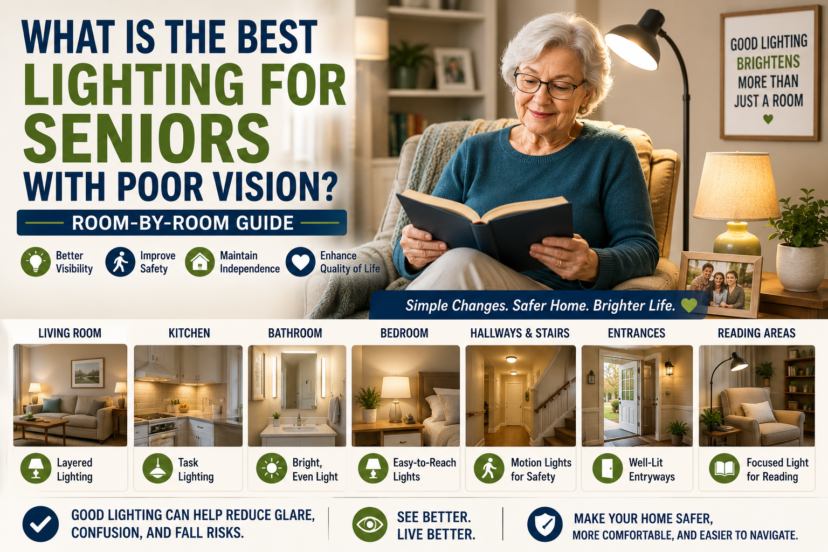
🛋️ Best Lighting For The Living Room
Living rooms usually serve several purposes. Someone may watch television, read, knit, talk with family, or move between furniture.
One ceiling fixture may not provide enough illumination for all these activities.
Layer the lighting instead.
Use comfortable general lighting throughout the room and add task lamps beside favorite chairs.
For reading, position the lamp so light reaches the book or newspaper without shining directly into the person’s eyes.
Look for dark pathways between the sofa, hallway, and other frequently used areas.
Also consider contrast. A light switch that blends into the wall may be difficult to locate.
Simple improvements can include:
- Floor or table lamps near seating
- Easy-to-operate switches
- LED bulbs appropriate for the fixture
- Window coverings that control harsh sunlight
- Motion lighting near dark passageways
These changes can make a living room more comfortable without changing its familiar appearance.
🍳 Best Kitchen Lighting For Seniors With Poor Vision
The kitchen is one of the most important rooms when considering what is the best lighting for seniors with poor vision.
Food preparation requires seeing small details, reading labels, measuring ingredients, and safely using knives and appliances.
Start with good overhead illumination.
Then add task lighting where work actually happens.
Under-cabinet lighting can illuminate countertops that upper cabinets otherwise leave in shadow.
Pay particular attention to:
- Food preparation areas
- Sink
- Stove
- Countertops
- Pantry
- Inside or near frequently used cabinets
Avoid positioning lights where they create strong reflections on polished countertops.
Good kitchen lighting should make ingredients, appliance controls, edges, and work surfaces easier to distinguish.
🛁 Best Bathroom Lighting For Older Adults
Bathrooms require careful lighting because they combine water, mirrors, changes in floor surface, and frequent sitting and standing.
Begin with bright, comfortable general illumination.
Then make sure the vanity and sink area have adequate lighting for grooming, shaving, medication-related tasks, or reading labels.
Avoid relying on one harsh overhead fixture.
Lighting positioned around the vanity may reduce strong facial shadows.
Nighttime bathroom access deserves special attention.
Consider motion-activated or low-level night lighting along the route from the bedroom to the bathroom. The goal is enough visibility to navigate safely without requiring someone to search for a switch in darkness.
Also ensure the toilet, shower entrance, grab bars, and floor transitions are easy to see.
🛏️ Best Bedroom Lighting For Seniors
A senior-friendly bedroom should provide both comfortable evening lighting and easy nighttime access.
Place a lamp or lighting control within easy reach of the bed.
Someone should not need to cross a dark bedroom just to turn on a light.
Useful improvements include:
- Bedside lamps
- Large or illuminated switches
- Motion-activated night lights
- Closet lighting
- Reading lights
- Clear illumination near the bedroom entrance
If nighttime bathroom trips are common, illuminate the complete route rather than only the bathroom itself.
This is an important principle when determining what the best lighting for seniors with poor vision is: think about transitions between rooms, not just individual rooms.
🪜 Best Lighting For Stairs And Hallways
Stairs deserve special attention because poor visibility can make judging steps more difficult.
Make sure the entire staircase is consistently illuminated.
Avoid having the top of the staircase brightly lit while the bottom remains dark.
Light switches should be conveniently accessible where appropriate, and motion-activated lighting may provide another useful option in some homes.
Check for shadows that obscure step edges.
Hallways should also have sufficient lighting from end to end, especially between bedrooms and bathrooms.
In addition to lighting, visual contrast may make stair edges, handrails, and floor transitions easier to identify.
If stair safety remains a concern despite improved lighting, an occupational therapist or aging-in-place professional can help evaluate additional modifications.
🚪 Best Lighting For Entrances And Exterior Walkways
Good lighting outside the home is just as important.
Check the route from the driveway or sidewalk to the front door after sunset.
Can you clearly see steps, pavement changes, railings, locks, and the door threshold?
Consider lighting for:
- Porch steps
- Walkways
- Driveways
- Garage entrances
- House numbers
- Door locks
- Exterior stairs
Motion-activated fixtures can be useful because the person does not have to locate a switch before approaching the house.
However, exterior lighting should illuminate the walking surface rather than shine directly into someone’s eyes.
📚 Best Lighting For Reading And Hobbies
Reading, puzzles, sewing, woodworking, model building, and other hobbies require more focused illumination than simply walking through a room.
This is where task lighting becomes valuable.
Position the lamp close enough to illuminate the activity without creating glare.
Adjustable lamps can help direct light exactly where it is needed.
For reading, light coming from the side or slightly behind the reader may be more comfortable than a bulb shining toward the face.
Individuals with specific eye conditions may have different lighting needs, so personal comfort matters.
If reading remains difficult despite good lighting and updated prescription lenses, an eye-care professional or low-vision specialist may be able to recommend additional strategies.
💡 What Type Of Light Bulbs Are Best For Seniors?
LED bulbs are practical for many U.S. homes because they are energy-efficient, widely available, and offered in many brightness levels and color temperatures.
But don’t choose a bulb based only on wattage.
For LEDs, lumens describe light output more directly than traditional wattage.
Also consider color rendering. A bulb with good color-rendering performance can make objects and colors appear more natural and easier to distinguish.
Color temperature affects the appearance of the light.
Warmer light often feels comfortable in bedrooms and living areas, while neutral or somewhat cooler lighting may work well for task-oriented spaces such as kitchens.
There is no single perfect bulb for every senior.
When asking what is the best lighting for seniors with poor vision, the better question is whether the light provides sufficient visibility without uncomfortable glare.
🌞 Make Better Use Of Natural Light
Daylight can make rooms feel brighter and more pleasant, but uncontrolled sunlight can also create glare.
Open curtains or blinds during the day when doing so improves visibility.
Keep windows reasonably clean and avoid placing large furniture where it unnecessarily blocks natural light.
If direct sunlight creates strong glare, use adjustable blinds, shades, or sheer curtains to diffuse it.
Also consider how daylight changes throughout the day.
A kitchen that looks bright at 10 a.m. may become surprisingly dark at 5 p.m.
Indoor lighting should compensate as natural light fades rather than waiting until the room becomes difficult to see.
⚠️ Avoid These Common Senior Lighting Mistakes
Installing brighter bulbs everywhere does not automatically create better lighting.
Common mistakes include:
- Using exposed bulbs that produce glare
- Creating bright pools of light surrounded by dark areas
- Leaving staircases partially illuminated
- Relying on one overhead fixture for detailed tasks
- Blocking windows with heavy furniture
- Using switches that are difficult to locate
- Ignoring nighttime routes
Another mistake is replacing every bulb at once without asking the older adult how the new lighting feels.
Lighting needs are personal.
Make improvements gradually and adjust them based on comfort and visibility.
🛠️ How To Improve Senior Lighting On A Budget
You do not need to hire an electrician to begin improving lighting.
Start with a nighttime walk-through.
Turn on the lights normally used and look for areas where visibility is poor.
Then prioritize inexpensive improvements:
First: Replace failed or inadequate bulbs with suitable bulbs rated for the fixture.
Second: Add lamps where detailed activities occur.
Third: Install plug-in or motion-activated night lights along nighttime routes.
Fourth: Reduce glare using shades, curtains, lampshades, or repositioned fixtures.
Fifth: Improve access to switches.
This approach can determine the best lighting for seniors with poor vision without immediately committing to a major renovation.
Address the most important visibility problems first and improve other areas gradually.
👷 When To Consult A Professional
Professional help may be appropriate when poor vision significantly affects mobility or daily activities.
An optometrist or ophthalmologist can evaluate changes in vision, while a low-vision specialist may recommend strategies tailored to a specific visual impairment.
An occupational therapist can evaluate how vision affects everyday tasks and home safety.
A Certified Aging-in-Place Specialist (CAPS), electrician, accessibility installer, or qualified contractor may be helpful when adding permanent fixtures, new switches, stair lighting, exterior lighting, or other electrical modifications.
Seek prompt healthcare evaluation for sudden vision loss, new double vision, flashes of light, a sudden increase in floaters, severe eye pain, or other significant or rapidly changing visual symptoms.
❓ Frequently Asked Questions About Lighting For Seniors With Poor Vision
What Is The Best Light Bulb For Elderly People With Poor Eyesight?
LED bulbs with adequate brightness, comfortable color temperature, and good color rendering are practical for many older adults. The ideal bulb depends on the room, task, fixture, and person’s specific visual needs.
Is Warm Or Cool Light Better For Seniors?
Neither is universally better. Warm light may feel comfortable in bedrooms and living rooms, while neutral light can work well for kitchens and task areas. Visibility and glare control are more important than choosing one color temperature throughout the house.
Are LED Lights Good For Seniors?
Yes, LEDs can be a good option because they are efficient, long-lasting, and available in many brightness levels and color temperatures. Choose appropriate bulbs and fixtures that minimize uncomfortable glare.
How Bright Should A Senior’s Home Be?
There is no single brightness level suitable for every senior or every room. Older adults often benefit from more illumination than younger adults, especially for detailed tasks, but excessive brightness and glare can also reduce comfort.
What Is The Best Lighting For Seniors At Night?
Low-level motion-activated lighting can be useful for nighttime routes, particularly between the bedroom and bathroom. It should provide enough illumination to identify obstacles and walking surfaces without creating excessive glare.
How Can I Reduce Glare For An Elderly Person?
Use lampshades, diffused fixtures, adjustable blinds or curtains, and matte surfaces where practical. Reposition lamps that shine directly into the eyes and avoid strong reflections from glossy surfaces.
Can Better Lighting Help Prevent Falls In Seniors?
Adequate lighting can improve visibility of obstacles, stairs, floor transitions, and walking paths, making it an important part of a broader fall-prevention strategy. Fall risk can have many causes, however, so recurring balance or mobility problems should be professionally evaluated.
🎯 Conclusion: What Is The Best Lighting For Seniors With Poor Vision?
Understanding what the best lighting for seniors with poor vision is does not mean filling every room with extremely bright lights.
Good senior-friendly lighting is thoughtful lighting.
Start with the places that matter most: stairs, bathrooms, kitchens, entrances, bedrooms, and nighttime walking routes.
Add task lighting where reading, cooking, grooming, or hobbies occur. Reduce glare. Eliminate unnecessary dark areas. Make switches easier to find.
Then ask the person using the space how it feels.
Sometimes a $15 night light or repositioned reading lamp can make a bigger practical difference than an expensive renovation.
Small improvements made throughout the home can create an environment that is easier to navigate, more comfortable to use, and better suited to changing vision.
With appropriate lighting, regular vision care, and thoughtful home safety improvements, older adults can continue enjoying greater confidence, independence, comfort, and quality of life at home.
Disclaimer: This content is for general informational purposes only and is not a substitute for professional medical, eye-care, healthcare, mobility, electrical, or home accessibility advice. Follow applicable local building and electrical codes and consult qualified healthcare providers, eye-care professionals, electricians, contractors, occupational or physical therapists, accessibility professionals, or Certified Aging-in-Place Specialists before making significant home modifications or beginning new exercise or mobility routines.
Explore more:
- How To Create A Dementia-Friendly Home
- What Home Changes Can Help Seniors With Memory Loss?
- Aging In Place On A Budget